

Choosing to invest in a perpetual calendar might actually be a mistake for the modern collector seeking the ultimate balance of utility and value. While the peak of high horology often feels gatekept by six-figure price tags, the annual calendar offers a sophisticated mechanical solution that only requires a single manual adjustment each year. It's understandable if you've felt overwhelmed by technical jargon or the fear of high maintenance costs associated with complex movements. Many enthusiasts find themselves stuck between basic date displays and the extreme price entry of a perpetual movement.
This guide simplifies that complexity by revealing why this specific complication is the smartest addition to your collection in 2026. You'll learn how to distinguish between these movements with confidence and discover the mechanical brilliance that makes them a stable long-term asset. We'll compare industry leaders like the Rolex Sky-Dweller and Patek Philippe, while showing you how professional sourcing and certified repair services protect your investment. From understanding gear trains to selecting a model that holds its value, you're about to find the perfect timepiece to elevate your lifestyle.
Key Takeaways
- Learn why an annual calendar is the horological "sweet spot" for collectors, offering nearly full automation with only one manual adjustment required each year.
- Understand the critical differences between annual and perpetual complications to make an informed investment that balances mechanical complexity with price.
- Explore the design and functionality of iconic models such as the robust Rolex Sky-Dweller and the elegant Patek Philippe Ref. 5396.
- Leverage professional sourcing services in New York City to find rare, high-ticket timepieces that aren't available on the public market.
- Gain insights into protecting your asset through certified repair and maintenance, ensuring your timepiece remains a legacy item for years to come.
What is an Annual Calendar Watch? The Mechanical Masterpiece Explained
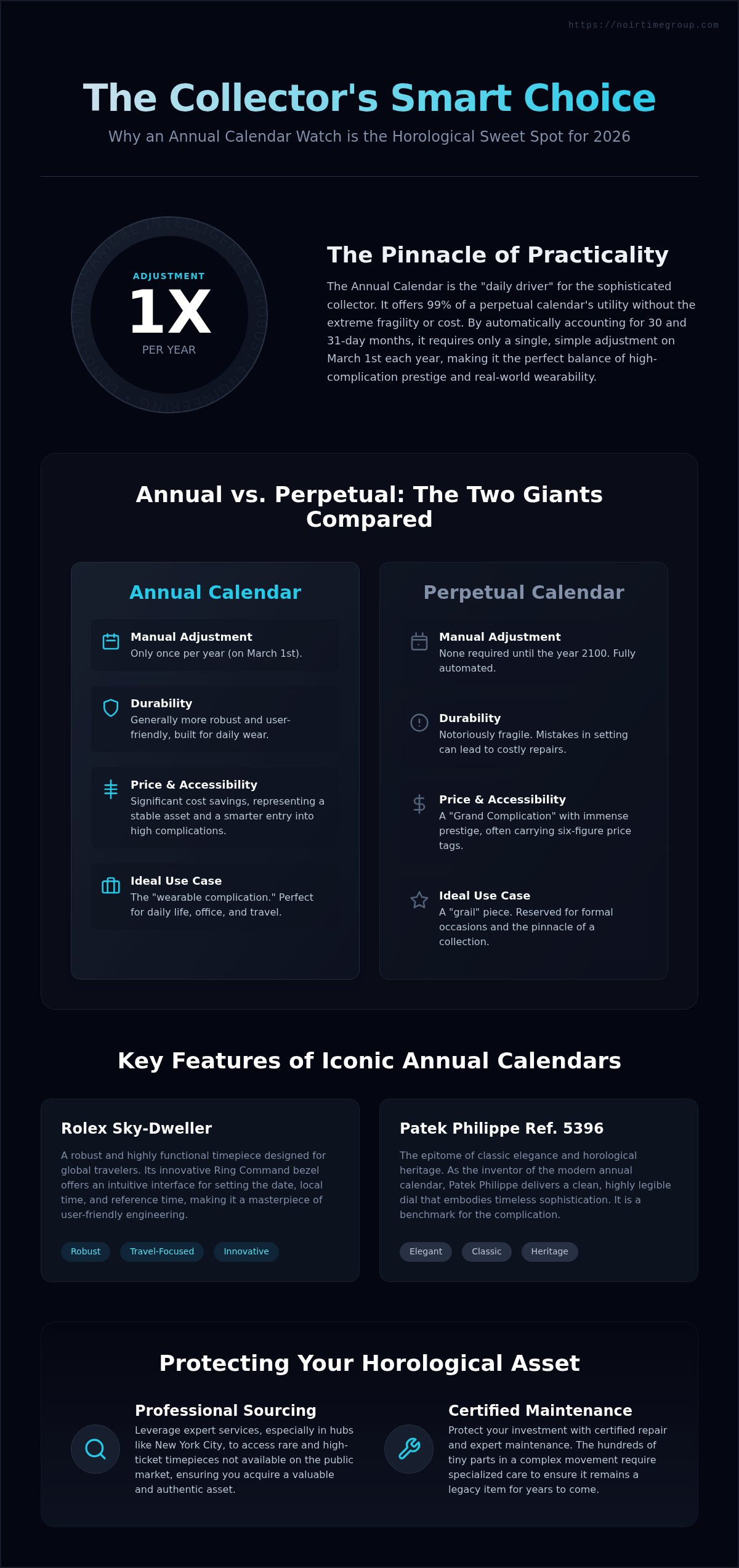
An annual calendar is a sophisticated horological complication that automatically tracks the date by accounting for months with 30 or 31 days. It's a significant step up from a standard date display, which requires manual adjustment five times per year. With this movement, you only need to touch the crown once. This adjustment happens on March 1st, as the mechanism isn't designed to recognize the leap year cycle or the shorter length of February. It's a simple, elegant solution for those who want mechanical intelligence without the extreme delicacy and high entry price of a perpetual calendar.
Patek Philippe introduced the first modern version of this complication in 1996. This invention filled a massive gap in the market, providing collectors with a high-complication experience that was robust enough for daily use. Since then, the annual calendar has become a staple for prestige brands. It's often viewed as the "daily driver" for the sophisticated collector because it offers prestige and utility in equal measure. These watches don't just tell time; they represent a pinnacle of engineering that manages the irregularities of our calendar system with minimal human input.
How the Annual Calendar Movement Works
The magic happens through an intricate system of wheels and cams. These components determine whether the date should skip from the 30th to the 1st or continue to the 31st. When researching What is an Annual Calendar Watch?, you'll find two primary construction methods. Integrated movements are designed as a cohesive whole from the start. Modular movements, however, place a calendar layer on top of an existing base caliber. Both methods require expert maintenance and certified repair services to keep the hundreds of tiny parts functioning perfectly. This mechanical density is exactly what drives the long-term investment value of the watch.
Why Collectors Prefer Annual Calendars in 2026
In the current market, collectors are moving toward "wearable complications." The annual calendar is the practical complication for modern life because it provides 99% of the utility found in a perpetual calendar without the same level of fragility. Dials remain clean and highly legible, avoiding the cluttered sub-dials often seen on more complex pieces. Whether you're looking at a Rolex Sky-Dweller for travel or a classic Patek Philippe for the office, these watches offer a perfect balance. They're easier to set, less expensive to service, and represent a stable asset in any luxury collection.
Annual Calendar vs. Perpetual Calendar: Comparing the Two Giants
While both complications belong to the upper echelon of horology, they serve different lifestyles and investment strategies. The primary mechanical distinction lies in how they handle the leap year cycle. A perpetual calendar is programmed to track the length of every month, including the variable 28 or 29 days of February, for over a century. In contrast, an annual calendar requires a manual correction once every year at the end of February. This small trade-off in automation leads to a significant difference in both entry price and daily wearability.
When performing an Annual vs. Perpetual Calendar comparison, consider the complexity of the movement. Perpetual movements are notoriously fragile. A single mistake while setting the time during the "danger zone" (usually between 9 PM and 3 AM) can lead to a costly trip to a service center. Annual calendars are generally more robust and user-friendly. If you're looking for a piece that can handle the rigors of travel or daily wear, the more durable gear system of an annual movement is often the superior choice.
The Perpetual Calendar Advantage
The perpetual calendar is often labeled a "Grand Complication." It represents a "set it and forget it" philosophy that won't require a date correction until the year 2100. Because of this extreme mechanical intelligence, these watches carry immense prestige and are typically reserved for formal occasions or "grail" status in a collection. They are masterpieces of miniaturization, though they often come with a thicker case profile to house the extra components needed for the leap year calculation.
The Case for the Annual Calendar
For many collectors in 2026, the annual calendar is the smarter financial move. You retain the high-end horological status of a complex movement while enjoying significant cost savings. Models like the Rolex Sky-Dweller prove that this complication can exist in a sporty, robust package without the delicacy of a formal dress watch. If you're ready to add a high-complication piece to your rotation, our expert sourcing service can help you find a model that fits your specific style and investment goals.
- Adjustment Frequency: Annual (Once per year) vs. Perpetual (Once per century)
- Price Point: Accessible Luxury vs. Ultra-High Entry
- Complexity: High vs. Very High
- Durability: Excellent for Daily Wear vs. Delicate for Occasional Wear
Key Features to Look for When Buying an Annual Calendar
Identifying the right annual calendar requires a balance between mechanical preference and physical wearability. While the movement is the heart of the watch, the case material and dial configuration determine how often you'll actually reach for it in your collection. Modern collectors often look for complication synergies where the calendar is paired with a GMT function or a moonphase. For instance, combining a dual-time display with an annual movement creates the ultimate travel companion for the frequent flyer. You should also prioritize watches with a quick-set function. This feature allows you to advance the calendar displays rapidly without cycling the hands through 24-hour rotations. It's a vital quality-of-life feature if you rotate your watches frequently and don't use a watch winder. These mechanical conveniences ensure that owning a complex timepiece remains a pleasure rather than a chore.
Selecting the Right Precious Metal
18k yellow gold remains a classic choice for those who appreciate a traditional luxury aesthetic. The weight of a solid gold piece, mirroring the presence of the Rolex Submariner Date 126618LN, provides a reassuring sense of value on the wrist. If you prefer a more understated look, platinum offers a stealth luxury appeal. It's heavier and more durable than gold, but its white luster is often mistaken for steel by the untrained eye. For those seeking a modern twist, rose gold provides a warmer tone that complements a variety of skin tones. Matching your metal choice to your existing accessories ensures a cohesive look for both professional and formal settings.
Dial Aesthetics and Legibility
The way a watch displays information is crucial for daily utility. Aperture-style displays, such as those found on the Patek Philippe 5396, use small windows to show the day and month on an annual calendar dial. This often results in a cleaner, more modern look than traditional pointer dates that use sub-dials. Clear legibility is essential for a watch designed to be a daily orientation tool. You don't want to squint at your wrist to determine the month during a busy meeting. A balanced, symmetrical dial layout significantly increases the long-term resale value of a luxury watch because it appeals to a wider range of collectors. Proportional spacing between the brand logo and the calendar windows creates a visual harmony that defines the highest levels of watchmaking.
Top Annual Calendar Models for Your Collection
Choosing the right annual calendar often comes down to a choice between modern utility and classic heritage. While many high-end brands have attempted this complication, only a handful have perfected the balance of legibility and mechanical reliability. In the 2026 market, these timepieces aren't just tools for tracking time; they're significant assets that hold their value through shifts in the industry. Whether you're looking for a robust traveler's watch or a refined dress piece, these models represent the pinnacle of current horology.
The Rolex Sky-Dweller Deep Dive
The Sky-Dweller is widely considered the most technically advanced watch in the current Rolex catalog. Its annual calendar mechanism, named the "Saros" system, is a marvel of engineering that uses only four additional gear wheels to distinguish between 30 and 31-day months. This simplicity ensures the movement remains robust enough for daily wear, unlike more delicate complications. You interact with the watch through the innovative Ring Command bezel. By rotating the bezel to different positions, you can set the date, local time, or reference time with ease. It's this combination of high-complication intelligence and tool-watch durability that makes the Sky-Dweller a favorite among New York's elite professionals.
Patek Philippe: The Inventor's Legacy
As the brand that invented the modern annual movement in the 1990s, Patek Philippe remains the gold standard for this category. The Ref. 5396 and 5205 models are iconic examples of how to display complex information with grace. These pieces typically feature a 38mm to 40mm case size, which has become the definitive aesthetic for a sophisticated dress watch. Many of these models integrate elegant 24-hour indicators and moonphase displays, offering a "Grand Complication" feel without the six-figure entry point of a perpetual calendar. You can browse our curated collection of annual calendar watches to find your next investment from this legendary house.
Audemars Piguet and Entry-Level Luxury
While the Royal Oak is frequently associated with perpetual calendars, rare annual versions of this iconic octagonal watch are highly prized by collectors. These pieces are often difficult to find on the open market and typically require a professional watch sourcing service to secure. For collectors looking to bridge the gap into high-end horology, brands like IWC and Zenith offer excellent alternatives. These models provide the mechanical satisfaction of a calendar complication while maintaining a price point that serves as a perfect entry into the world of luxury watch collecting. Each of these brands brings a unique perspective to the "once-a-year" adjustment rule, ensuring there's a model to suit every personal style and technical preference.
Buying and Sourcing Your Annual Calendar in New York
Buying a high-complication timepiece in New York requires more than just a transaction; it demands a partnership built on trust and technical expertise. When you're ready to acquire an annual calendar, verifying the provenance of the piece is the most critical step in protecting your capital. The secondary market for Patek Philippe and Rolex is vast, but searching for these items alone often leads to risks regarding authenticity or hidden mechanical issues. Working with a local NYC retailer ensures that every gear and spring in that complex movement has been inspected by professionals who understand the nuances of high horology.
Many collectors begin their journey with a robust tool watch, like a Rolex Submariner Date 126613LN or 126618LN. As your collection matures, trading these recognizable icons for a sophisticated complication is a natural progression. This shift allows you to move from a widely available model to a piece with higher mechanical rarity. Our trade-in process simplifies this transition, allowing you to leverage the value of your current collection to secure a masterpiece that offers greater long-term appreciation and horological interest.
The Noir Time Group Concierge Experience
Acquiring a rare Patek Philippe or an Audemars Piguet Royal Oak often requires access to off-market inventory that never reaches public listings. Our watch sourcing service leverages a deep professional network in New York to find these specific references for our clients. You don't have to wait years on a boutique list when you have a partner who can navigate the global supply chain on your behalf. We provide personalized guidance for first-time complication buyers, explaining the specific maintenance needs of an annual calendar so you can enjoy your investment without worry. Having a New York-based partner for these high-value transactions provides a level of security and transparency that digital platforms can't match.
Securing Your Investment
The value of a high-complication watch is inextricably linked to its service history. Because these movements contain hundreds of microscopic parts, they require certified watch repair to maintain their accuracy and resale potential. Every timepiece we source comes with the assurance of expert maintenance and a commitment to after-sales care. This support ensures that your watch remains a functional asset rather than a liability for decades. Protecting your investment involves regular check-ups and specialized handling that only certified experts can provide. If you're ready to take the next step in your horological journey, explore the Annual Calendar Collection at Noir Time Group and secure your timepiece today.
Elevate Your Collection with a Timeless Complication
The annual calendar represents a masterclass in balance, offering nearly all the mechanical intelligence of a perpetual movement with far greater durability for daily wear. You've seen how these pieces bridge the gap between simple date displays and ultra-complex horology, providing a sophisticated orientation tool that only needs your attention once a year. Whether you choose the robust utility of a Rolex Sky-Dweller or the classic elegance of a Patek Philippe, you're investing in a piece of engineering that holds its value through shifting market trends.
Securing such a high-ticket item in the 2026 market requires a partner you can trust. Our NYC-based team provides an expert sourcing service to locate rare, off-market models, all backed by guaranteed authenticity. Beyond the purchase, our certified luxury watch repair and maintenance services ensure your timepiece remains a high-performing asset for the long term. Ready to find your perfect match? Shop the Annual Calendar Collection at Noir Time Group to explore our curated selection of horological masterpieces and start your next chapter in collecting with confidence.
Frequently Asked Questions
What is the difference between an annual calendar and a standard date watch?
An annual calendar automatically accounts for the differing lengths of months with 30 and 31 days. A standard date watch, by contrast, treats every month as having 31 days, meaning you have to manually advance the date five times per year. With an annual complication, you only need to adjust the movement once on March 1st. This mechanical intelligence provides a significant upgrade in convenience and horological prestige for serious collectors.
Do I need to wind my annual calendar watch every day?
You don't need to wind it daily if the watch is an automatic model and you wear it regularly. Most modern complications, like those found in our Patek Philippe or Rolex inventory, feature power reserves that last between 45 and 72 hours. If the watch sits idle for several days, the movement will stop. In that case, you'll need to manually wind it and reset the calendar displays to ensure the gears remain synchronized.
What happens if I forget to adjust my annual calendar at the end of February?
If you forget to adjust your timepiece on March 1st, the watch will simply display the incorrect date. Since the mechanism doesn't recognize that February has only 28 or 29 days, it will advance to February 29th instead of March 1st. You won't damage the movement by forgetting. You just need to use the crown or pushers to advance the date manually until it matches the current day.
Which brand makes the most reliable annual calendar movement?
Reliability often depends on your lifestyle and how you intend to wear the piece. Patek Philippe is the gold standard for elegance and traditional craftsmanship, having invented the modern version of this complication. However, the Rolex Sky-Dweller is widely considered the most robust option for daily wear. Its Saros system uses fewer moving parts than traditional designs, which often results in greater durability and a longer interval between required professional maintenance sessions.
How much does it cost to service an annual calendar complication?
Servicing costs for these timepieces are generally higher than for standard three hand watches because of the increased mechanical complexity. An annual calendar contains hundreds of specialized components that require expert attention. While we don't provide flat rates, the investment in certified luxury watch repair is essential for maintaining the asset's long term value. Regular maintenance prevents gear wear and ensures that the intricate calendar wheels continue to transition precisely every month.
Is an annual calendar watch a good investment for 2026?
High complication watches from blue chip brands like Patek Philippe, Rolex, and Audemars Piguet remain strong investment choices in 2026. These pieces are produced in lower quantities than standard models, which often leads to better value retention on the secondary market. As collectors increasingly look for mechanical depth, the annual complication offers a "sweet spot" of rarity and utility. Our sourcing service focuses on acquiring these specific references because they represent stable assets for modern portfolios.
Can I wear an annual calendar watch while swimming or diving?
Most annual calendars are housed in dress watch cases and aren't designed for water activities. While models like the Rolex Submariner Date 126618LN are built for diving, calendar complications are typically more delicate. The Rolex Sky-Dweller offers 100 meters of water resistance, making it suitable for surface swimming. However, you should always check the specific gaskets and depth ratings before exposing any high complication timepiece to water to avoid costly internal damage.
How does the Rolex Sky-Dweller differ from other annual calendars?
The Sky-Dweller stands out because of its unique Saros system and Ring Command bezel. Unlike traditional calendars that use multiple sub dials or hidden pushers, the Rolex design displays the month through twelve apertures around the dial. You use the rotating bezel to select which function you want to adjust. This integration makes it much more user friendly than other models, especially when you're traveling across different time zones frequently.
