
There’s no single fixed cut: if you’re asking what percentage do watch dealers take when buying a watch outright, a common rule of thumb is about 50% of the price the dealer expects to ask for it in their shop. That’s a guide, not a universal rate, and it differs from a dealer’s commission on a sale made for you.
It’s understandable to focus on the difference between your watch’s original retail price and a dealer’s offer, but those figures are not always directly comparable. An offer also reflects the watch’s likely resale value and the dealer’s costs.
This article explains how an outright offer affects your proceeds, how secondary-market prices compare with authorized-dealer prices, and how gray-market distribution works. You’ll also see why the brand, model, condition, and sales channel can change the figures, helping you understand what a dealer’s offer represents.
Key Takeaways
- Separate an outright purchase offer from a commission on a sale handled for you; they describe different ways a dealer earns money.
- Compare gray-market prices with authorized-dealer prices by the exact watch reference, since discounts and premiums can differ widely.
- Use the watch’s likely resale value, condition, and dealer costs to understand an offer; dealer costs are often around 50% of manufacturer retail price, with variation by brand.
- When exploring a specific Rolex or looking for a timepiece, consider how a sourcing service or certified repair fits your needs.
Gray-market watch dealers and distribution channels
Gray-market dealers sell watches through channels outside brand-authorized retail. This route can affect buyer prices and seller proceeds in different ways.
Commission Differences Across Watches
Commission varies with the reference, demand, condition, and route to sale. Gray-market luxury watches can cost 20-30% below list, depending on model and reference. The Omega Speedmaster Professional Moonwatch reference 310.30.42.50.01.001 costs about 31% less on the gray market than at the manufacturer. That buyer discount isn’t a seller commission. To negotiate a selling fee, compare written net proceeds for the same watch and ask which deductions apply.
Dealer Markup and Seller Commission
A dealer’s markup is the difference between its acquisition cost and resale price. A seller commission is an agreed deduction from proceeds when a dealer sells your watch for you. The distinction matters: markup belongs to the dealer’s resale transaction, while commission comes from your sale arrangement. For example, a 20-30% gray-market discount from list price doesn’t show what an intermediary keeps from a seller.
Outright Purchases and Resale Fees
An outright buyer pays you and takes ownership; consignment leaves the watch with a seller until it sells. One market rule of thumb puts an outright offer near 50% of the dealer’s expected shop price for that used watch. Resale platforms deduct their stated seller charges from a completed transaction, so compare net proceeds, not headline offers. Before signing a consignment agreement, read the commission basis, extra deductions, payment timing, sale term, return process, and responsibility for loss.
Fees Beyond Commission
A selling agreement may assign authentication, servicing, shipping, insurance, or payment-processing charges to the seller, in addition to commission. Ask for every charge in writing, including who pays it and whether it applies if the watch does not sell. Confirm whether servicing needs your approval before work begins and how an unsold watch will be returned. These terms affect your net proceeds even when the headline commission stays the same.
What percentage of a watch's sale price do dealers pay when buying it outright?
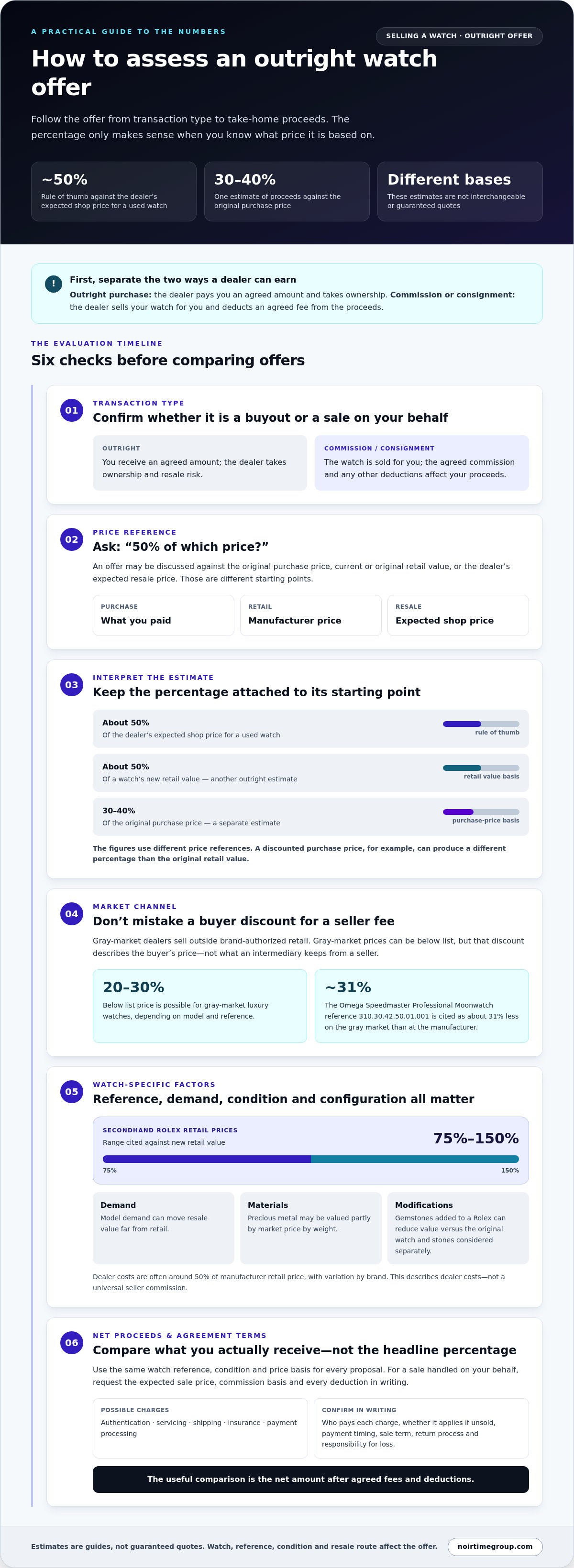
For an outright purchase, a common estimate is about 50% of a watch’s new retail value. Another estimate puts a seller’s proceeds at 30-40% of the original purchase price. These figures use different starting points, so they aren’t interchangeable. A watch bought at a discount, for example, can produce a different percentage of its purchase price than of its original retail value.
The offer also reflects what the dealer expects to recover through resale. A retailer may offer about 50% of its expected shop price for a used watch. That calculation starts with the anticipated resale price, not necessarily the watch’s original list price. Condition, demand for the specific model, and the dealer’s selling costs shape the expected resale value and therefore the cash offer.
Compare each offer using the same reference point: original purchase price, current retail value, or expected resale price. Then compare the cash you would actually receive after deductions. When a dealer buys outright, you receive an agreed amount and do not wait for a later sale. The trade-off is that the offer reflects the buyer’s resale risk and operating costs.
If you’re evaluating an outright offer before choosing your next watch, a Watch Sourcing Service can help locate a specific timepiece.
These aren’t buyout quotes.
Do watch dealer commissions vary by brand, model, or sale price?
Yes. A dealer’s cost structure and expected resale value vary by brand and reference, while commission terms depend on the sale arrangement. Watch dealers’ costs are often around 50% of manufacturer retail price, with variation by brand. That figure describes dealer costs, not a universal seller commission. For a seller, the key comparison is the net amount offered after the agreed fee and deductions.
Model demand can move resale value far from retail. Secondhand Rolex retail prices may range from 75% to 150% of new retail value. That spread means two Rolex references can support very different resale expectations, even before condition enters the calculation. A popular model and a slower-moving reference may therefore lead to different offers or selling terms. The brand name alone doesn’t determine what the seller receives.
Materials and modifications matter, too. A precious-metal watch may be valued partly by the metal’s market price by weight. Adding gemstones to a Rolex can reduce the watch’s value compared with the original watch and stones considered separately. These factors affect expected sale value, which can shape an outright offer or the amount left after commission. The reference, original configuration, and material composition are more useful for comparing proposals than the brand alone.
Compare offers on the same basis: model and reference, condition, expected sale price, commission, and deductions. Calculate the net amount instead of comparing percentages in isolation. A lower commission on a watch expected to sell for less, for example, may leave you with less than a higher commission on a watch with a stronger resale estimate. Ask whether the fee is calculated on the final sale price or another agreed amount, and get that basis stated in the agreement. This makes offers across brands and models easier to assess without confusing dealer costs with seller fees.
What are typical watch dealer fees for Rolex, Patek Philippe, and Audemars Piguet?
There isn’t one standard seller-fee percentage for Rolex, Patek Philippe, or Audemars Piguet. Dealer costs are often around 50% of manufacturer retail price, with variation by brand. That figure describes dealer costs, not a fixed commission charged to a seller. A seller may ask, “What percentage do watch dealers take?” The answer depends first on whether the dealer buys the watch outright or sells it on consignment.
For a Rolex, the exact reference and its resale demand help shape a dealer’s expected return. A Patek Philippe Nautilus or Audemars Piguet Royal Oak also needs to be assessed by reference, condition, and configuration. Brand recognition alone does not establish the seller’s fee. Different references have different resale prospects, while the commission is set by the sale agreement.
Keep three figures distinct when reviewing an offer: manufacturer retail price, expected resale price, and your net proceeds. The approximate dealer-cost figure relates to manufacturer retail price. It does not mean a dealer automatically keeps half of a sale or that a seller automatically receives the other half. For consignment, focus on the stated commission and deductions. For an outright purchase, compare the offer with the watch’s likely resale value.
Before consigning a Patek Philippe Nautilus or Audemars Piguet Royal Oak, ask directly: “What percentage do watch dealers take from the sale price, and what other deductions apply?” Identify the reference and condition used in the assessment, then clarify how the fee is calculated. Asking the same questions for each watch makes the terms easier to compare without assuming that Rolex, Patek Philippe, and Audemars Piguet share one standard rate.
If you’re looking for a particular reference rather than selling, explore watch sourcing options for sought-after models such as the Patek Philippe Nautilus and Audemars Piguet Royal Oak.
Noir Time Group: Rolex Submariner Date 126613LN
Noir Time Group offers the Rolex Submariner Date 126613LN for readers considering a specific Rolex rather than a sale arrangement. It also offers the Rolex Submariner Date 126618LN, giving you two Submariner Date references to explore. If you’re looking for a particular watch, its Watch Sourcing Service provides a route to discuss that search.
For an owned watch that needs attention, Noir Time Group also offers Certified Watch Repair. These services meet different needs: sourcing helps you find a timepiece, while repair addresses servicing. Knowing whether you’re buying, searching, or maintaining a watch helps focus the next conversation.
Contact Noir Time Group to discuss the Rolex Submariner Date 126613LN or a watch-sourcing request.
Choose the Watch Move That Fits Your Plans
Before making your next move, decide what matters most: receiving a direct offer, arranging a sale, or finding a watch to keep. Knowing what percentage watch dealers take is useful, but your decision should also reflect what you want to do next and which terms you are comfortable accepting. A clear goal helps you focus conversations on the right outcome.
If you’re shifting from seller research to exploring a purchase, Noir Time Group offers the Rolex Submariner Date 126613LN and Rolex Submariner Date 126618LN, as well as a Watch Sourcing Service. These are relevant options when you’re searching for a specific watch rather than comparing dealer deductions.
Take the next step at your own pace, with your preferred model or search in mind. Contact Noir Time Group to discuss watches and move forward with confidence.
Frequently Asked Questions
What commission percentage do watch dealers charge to sell a watch on consignment?
There is no single commission percentage for every consignment; the rate and deductions depend on the agreement. Before signing, ask for the commission basis in writing and identify any separate charges. For example, clarify whether the percentage comes from the final sale price and how approved servicing or shipping costs affect your payout. Compare expected net proceeds, not just the headline rate.
